

RIA Ideas - Protection that upgrades itself
Protection Booster · Worst-of AMZN / MSFT / GOOG
What if the rally itself bought the downside protection?
The five biggest cloud companies (Amazon, Alphabet, Meta, Microsoft, Oracle) sell for about 22 times expected earnings. In 2020 it was 38. The typical S&P 500 stock is around 18, so the biggest names in the market now cost about four points more than an ordinary one, their lowest multiple in a decade (Goldman Sachs via Volatility Pulse, 9/27/2026).
This note owns three of them: Amazon, Microsoft and Alphabet. It pays 2.6 times whatever the weakest of the three gains over five years, and it starts with a 70% barrier. Here is the twist. If the three, averaged together, close 20% higher on any day in the first six months, the barrier goes away and the note becomes 100% principal protected (as long as BNP performs). In a daily backtest back to 2014, this note becomes principal protected 48% of the time (Yahoo Finance daily closes, equal-weight average of the three, start dates 3/2014 to 3/2026, as of 9/29/2026).
The biggest names in the market, priced closer to an ordinary stock than at any point in a decade
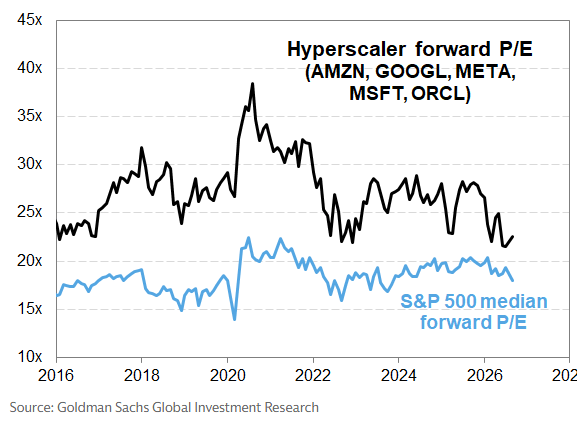
Chart: Goldman Sachs Global Investment Research, via Volatility Pulse 9/27/2026 (posted by Mike Zaccardi). Five names shown; the note references three of them. · marinelayeradvisors.com/insights
Here is the example. These are BNP Paribas indicative terms as of 9/30/2026, and they may change with market conditions:
5-Year Growth Note with a Protection Boost
BNP Paribas · Worst-of AMZN / MSFT / GOOG
Upside at maturity | ~260% of the gain in the worst performer of the three, uncapped, paid only at maturity |
Protection boost | Measured on an equal-weight basket of the three. If that basket closes at or above 120% of its start on any day in the first 6 months, the note becomes 100% principal protected from its initial value (depending on the issuer performing) |
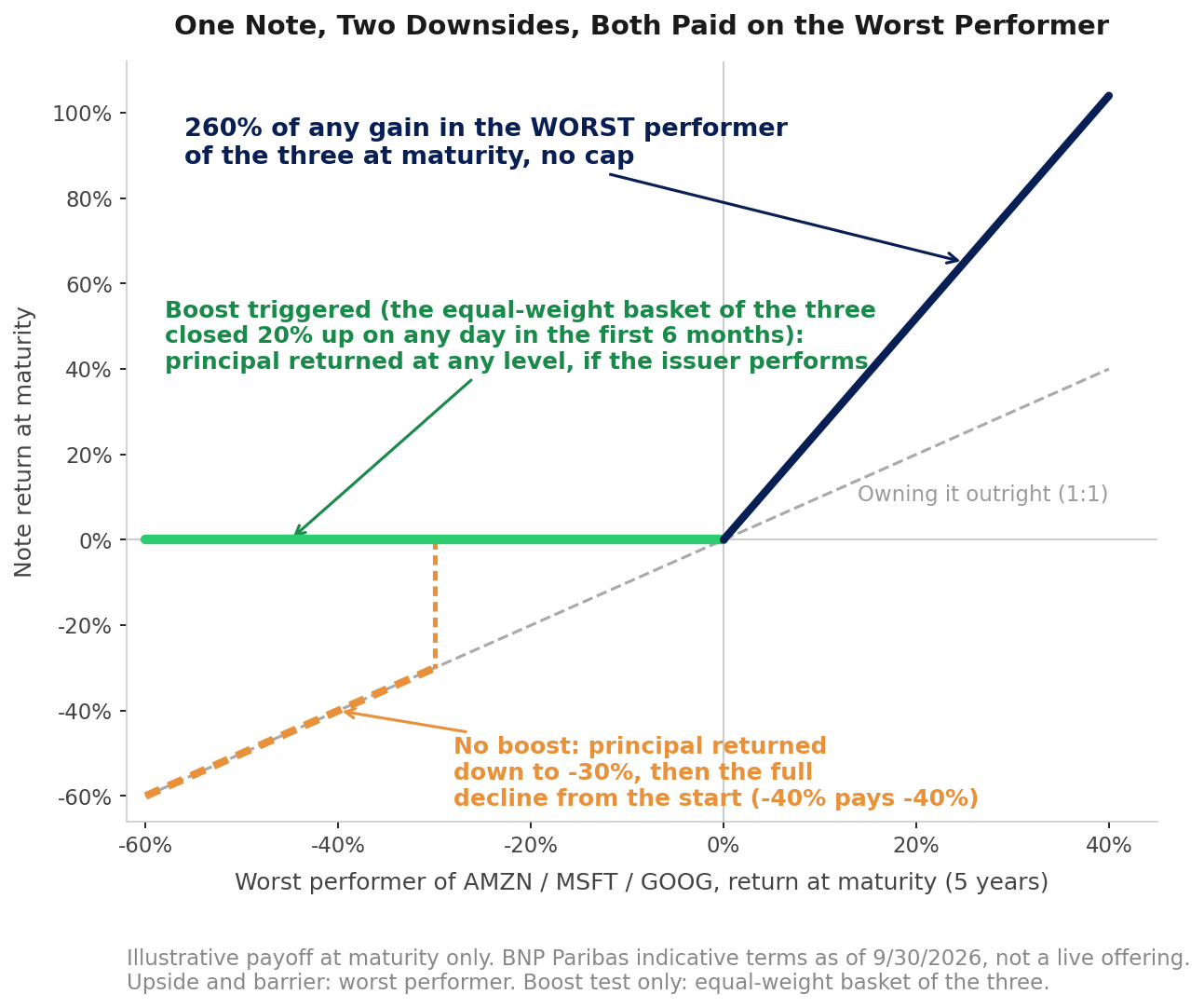
Downside if no boost | 70% barrier on the worst performer, measured at maturity. Principal returned if the worst performer is down 30% or less; below that, its full decline from the start (down 40% pays down 40%) |
Principal | All payments on the note are obligations of the issuer and are subject to its credit risk. |
Tenor / coupons | 5 years, no coupons |
The upside and the barrier key off the worst performer of Amazon, Microsoft and Alphabet; only the boost test uses the equal-weight basket of the three. At maturity the note may pay ~260% of any gain in the worst performer, with no cap. If the boost triggered in the first six months, principal may be returned at any level, if the issuer performs. If it never triggered, principal may be returned as long as the worst performer is down 30% or less, and below that the note may take its full decline from the start. If the structure appeals but the names do not, the underliers can be changed: other stocks or indices, subject to issuer availability at the time of pricing.
BNP Paribas indicative terms as of 9/30/2026. Not a live offering. Pricing can vary depending on market conditions.
Here is how the note may pay at maturity, in both states:
Want to see more thematic trades for your customers?
Any investment decision must be based solely on the issuer’s prospectus and pricing supplement, which are available on request.
This material is intended solely for the recipient and may not be forwarded, reproduced or distributed to retail investors.
This material is for informational purposes only and does not constitute a recommendation or an offer to buy or sell any security. All note terms shown are BNP Paribas indicative terms as of 9/30/2026, are marked with a tilde where approximate, and are subject to change, final pricing, issuer availability and market conditions at the time of execution. The note references the worst-performing of Amazon, Microsoft and Alphabet for its upside participation and its barrier; the protection boost is tested on an equal-weight basket of the same three names, so a gain in the basket may coincide with a loss in the worst performer. The 48% figure is our own calculation on Yahoo Finance daily closes for an equal-weight average of AMZN, MSFT and GOOG with overlapping daily start dates from 3/2014 to 3/2026, tested against a 120% close on any day in the following 126 trading days; it is a historical frequency, not a probability for any future period, and has not been independently verified. The forward price-to-earnings chart is Goldman Sachs Global Investment Research’s as published and covers five companies, of which the note references three; it has not been independently verified. Return of principal depends on the issuer performing its obligations in full. The notes are unsecured senior obligations of the issuer, are not insured or collateralized, and an issuer default or credit deterioration could result in the loss of some or all of an investment regardless of how the underliers perform. If the protection boost is not triggered, principal is at risk: if the worst performer finishes more than 30% below its initial level at maturity, the investor may lose 1% of principal for every 1% of its decline from the initial level. The boost, if triggered, applies to principal only and does not guarantee any return. The notes pay no interest, are not listed on any securities exchange and may have limited or no interim liquidity. Past performance is not indicative of future results. Structured notes involve risks including potential loss of principal and may not be suitable for all investors.