

RIA Ideas - Paging Dr.Alpha
Barrier Growth Note · XLV (S&P 500 Health Care)
Health care insiders are still buying. A year after past buying waves, XLV was higher 97% of the time.
Corporate insider buying has cooled almost everywhere this year, except in health care, where insiders keep adding. Since 2010, in the year after that buying reached today’s level, XLV posted a positive return 97% of the time, with a median gain of 15% (SentimenTrader, backtest through 10/8/2026, via Volatility Pulse 10/11/2026).
Meanwhile the sector has been left behind. XLV, the ETF for the S&P 500 health care sector, is up 11% this year against 37% for XLK, the tech sector ETF, and 14% for the S&P 500 (Yahoo Finance, as of 10/13/2026). A barrier growth note is one way to own a possible catch-up: about 108% of any XLV gain over three years, with principal returned as long as XLV is not down more than 30% at maturity (indicative levels priced 10/13/2026).
Insider buying in health care, and what XLV did in the year after
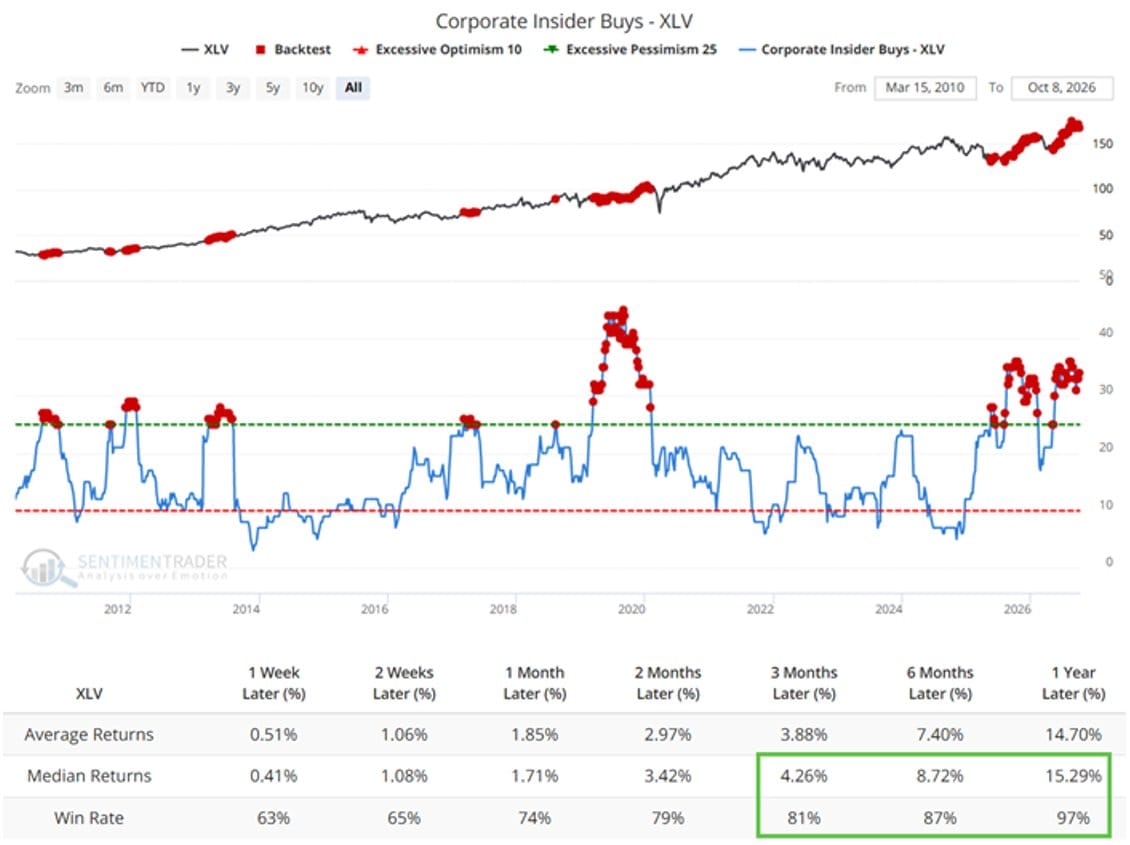
Chart: SentimenTrader, posted by Jay Kaeppel 10/8/2026, via Volatility Pulse 10/11/2026. Backtest March 2010 to October 8, 2026. · marinelayeradvisors.com/insights
Health care has lagged all year
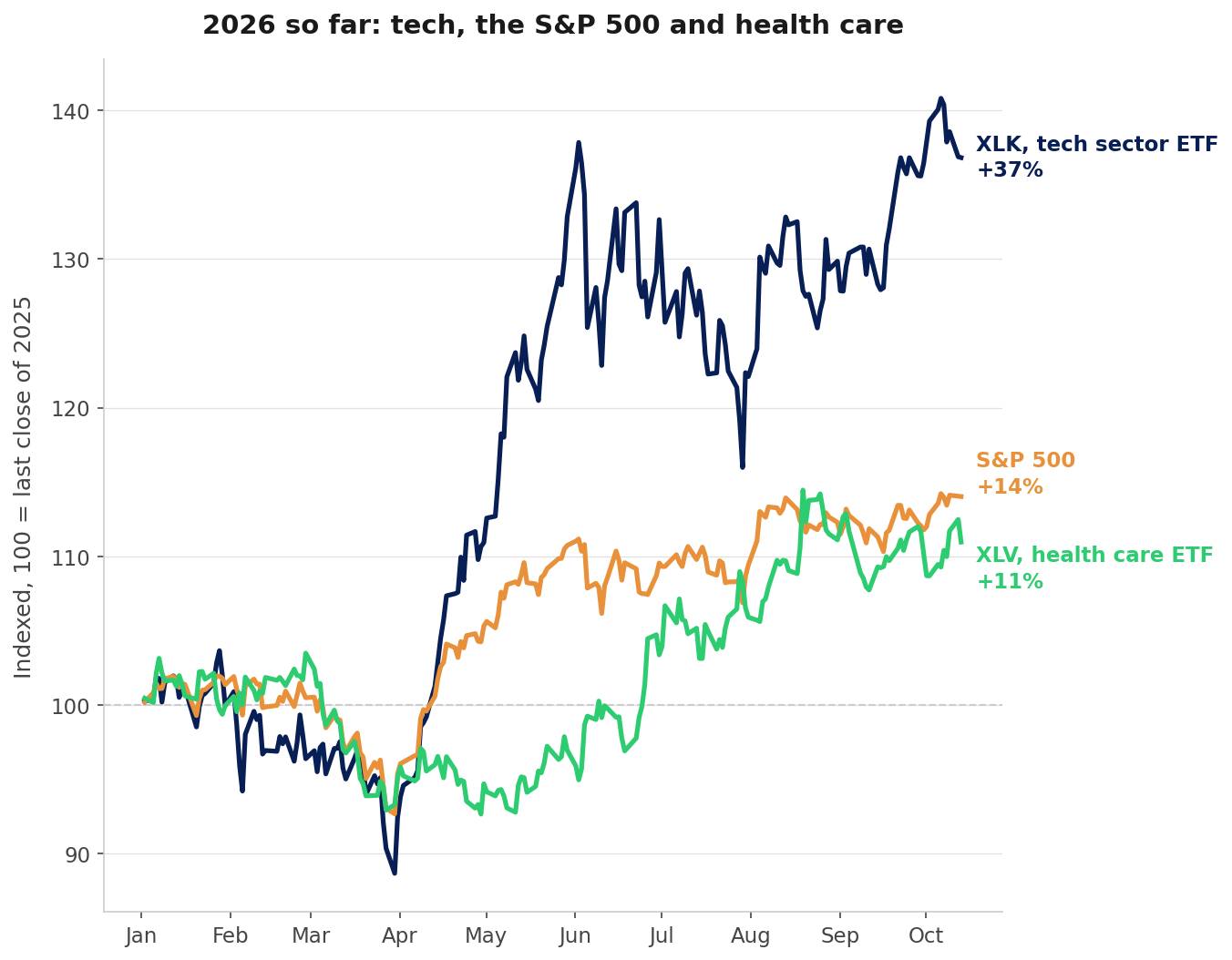
Source: Yahoo Finance, daily closes, as of 10/13/2026. Returns indexed to the last close of 2025.
The structure, indicatively priced on 10/13/2026:
3-Year Barrier Growth Note
XLV (Health Care Select Sector SPDR, the S&P 500 health care sector) · Indicative levels
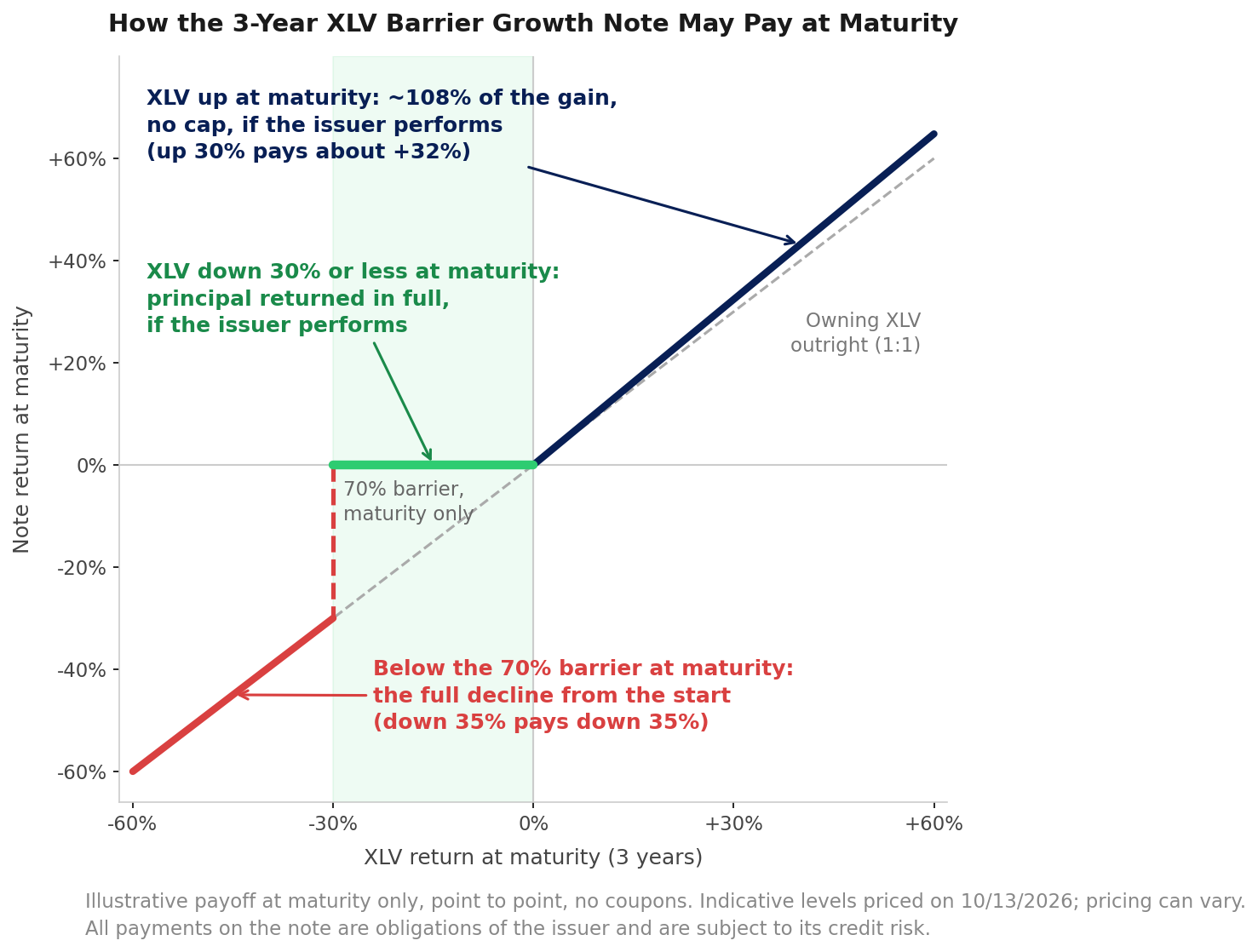
Upside at maturity | ~108% of any XLV gain, uncapped, paid only at maturity |
Downside | 70% barrier, observed at maturity only. Principal returned if XLV is down 30% or less; below that, the full decline from the start (down 35% pays down 35%) |
Principal | All payments on the note are obligations of the issuer and are subject to its credit risk. |
Tenor / coupons | 3 years, no coupons |
Held to maturity, the note may pay about 108% of any XLV gain with no cap, and may return principal in full as long as XLV is down 30% or less, in both cases only if the issuer performs. Below the barrier there is no cushion: the note may take XLV’s full decline from its start, and nothing is paid before maturity. If the structure appeals but the sector does not, the underlier can be changed, subject to issuer availability at the time of pricing.
These were indicative levels priced on 10/13/2026. Pricing can vary depending on market conditions.
Here is how the note may pay at maturity:
Want to see more thematic trades for your customers?
Any investment decision must be based solely on the issuer’s prospectus and pricing supplement, which are available on request.
This material is intended solely for the recipient and may not be forwarded, reproduced or distributed to retail investors.
This material is for informational purposes only and does not constitute a recommendation or an offer to buy or sell any security. The insider buying chart and its forward-return table are SentimenTrader’s as published on 10/8/2026 (backtest March 2010 to October 8, 2026); the return data is Yahoo Finance’s as of 10/13/2026; none of it has been independently verified. A historical win rate describes past signals only and says nothing about the next one. All terms shown are indicative levels priced on 10/13/2026 and are subject to change, final pricing, issuer availability and market conditions at the time of execution; they do not represent an offer or a quotation. Values marked with a tilde are approximate. Return of principal depends on the issuer performing its obligations in full. The notes are unsecured senior obligations of the issuer, are not insured or collateralized, and an issuer default or credit deterioration could result in the loss of some or all of an investment regardless of how XLV performs. The 70% barrier provides contingent protection only: if XLV finishes below 70% of its initial level at maturity, the investor is exposed to the full decline of XLV from its initial level, with no cushion. The offering documents may call this level a knock-in or trigger level; their defined terms govern. The notes pay no interest, are not listed on any securities exchange and may have limited or no interim liquidity. Past performance is not indicative of future results. Structured notes involve risks including potential loss of principal and may not be suitable for all investors.