

RIA Ideas - Hedging Made Simple
Rules-Based Tail Hedging · RBC Indicative Example
Tail risk, planned ahead instead of promised.
Most hedges die on two questions: what they cost while nothing goes wrong, and who decides when to cash one in. Clients rarely leave over a drawdown. They leave because nobody told them the plan beforehand.
Rules-based tail hedging answers both in advance, sized per client or per team as a sleeve rather than a swap of the equity allocation. One client's tail risk is concentrated tech, another's is small caps. Which exposures would you want a plan around first?
Here is an example, indicatively priced by RBC on 9/4/26 (terms may change with market conditions):
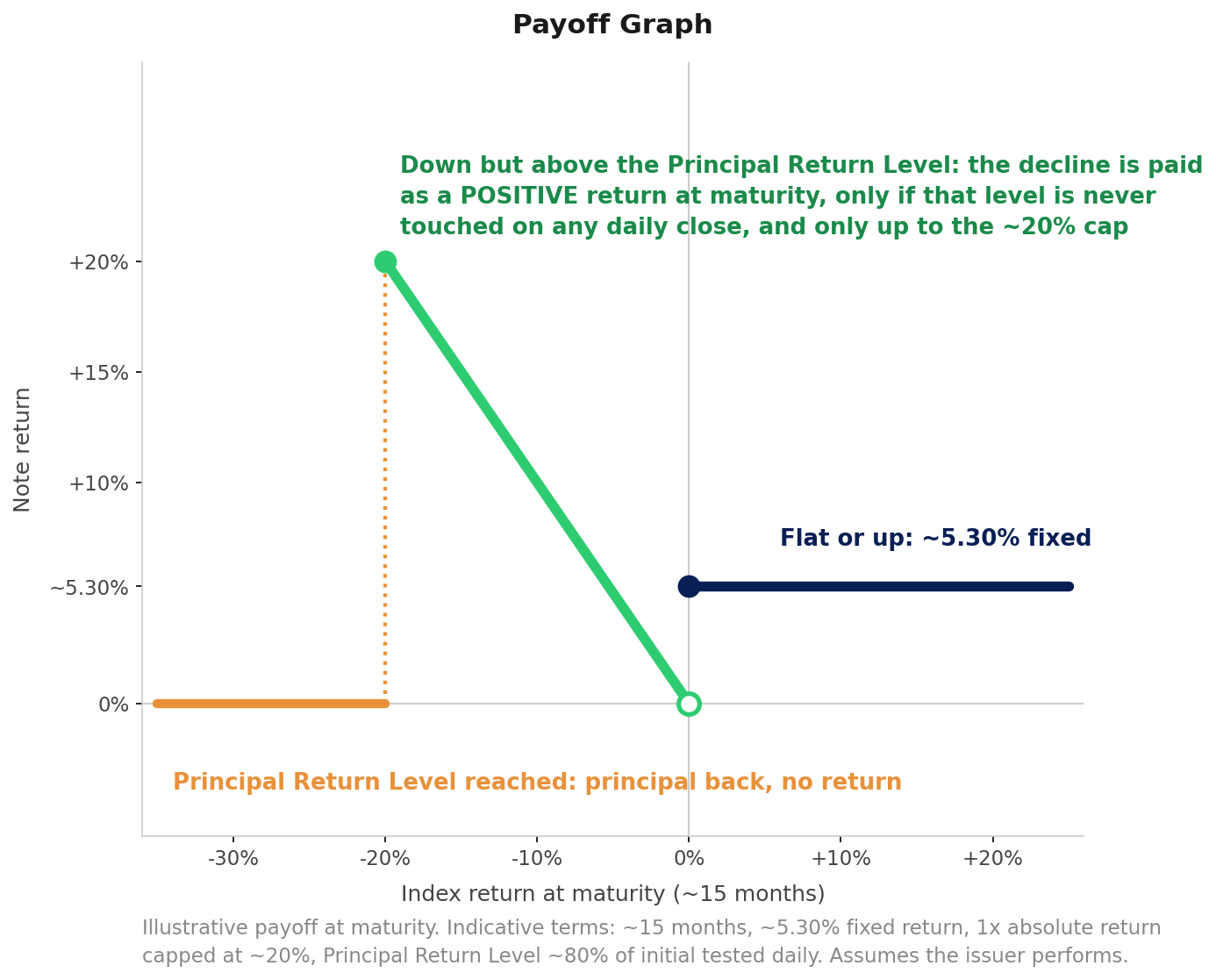
~15 months on the S&P 500. Flat or higher pays a fixed ~5.30%. Lower, having never closed 20% down on any single day, pays that decline back as a positive return up to a ~20% cap. Close 20% down on any single day and it ends early, returning principal. Return of principal depends on the issuer performing. No interest along the way. Three outcomes, set on day one.
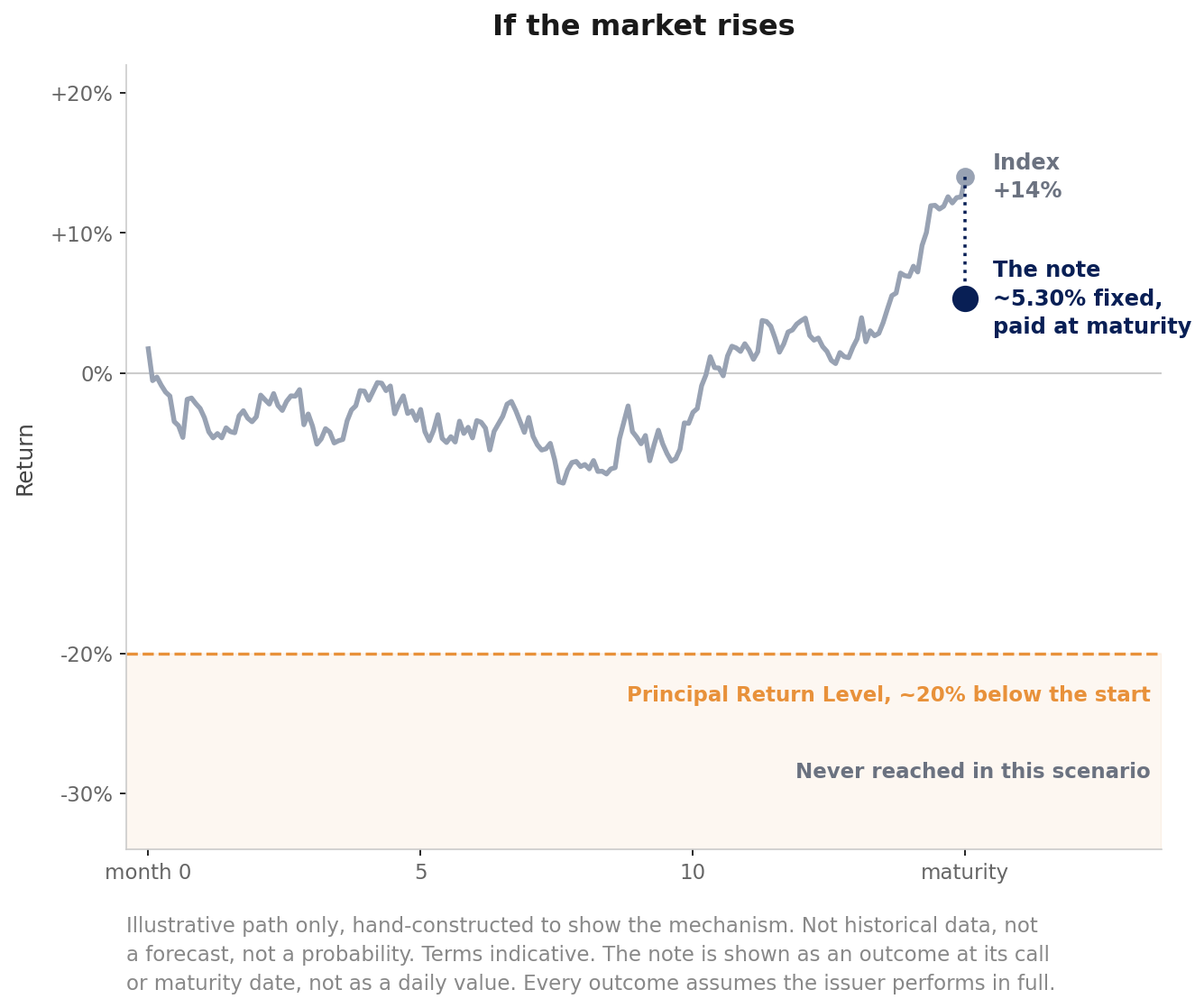
The equity book does the work and this sleeve does something quieter: a bond-like return, known on day one. Giving up upside on a small slice is what pays for the other two scenarios.
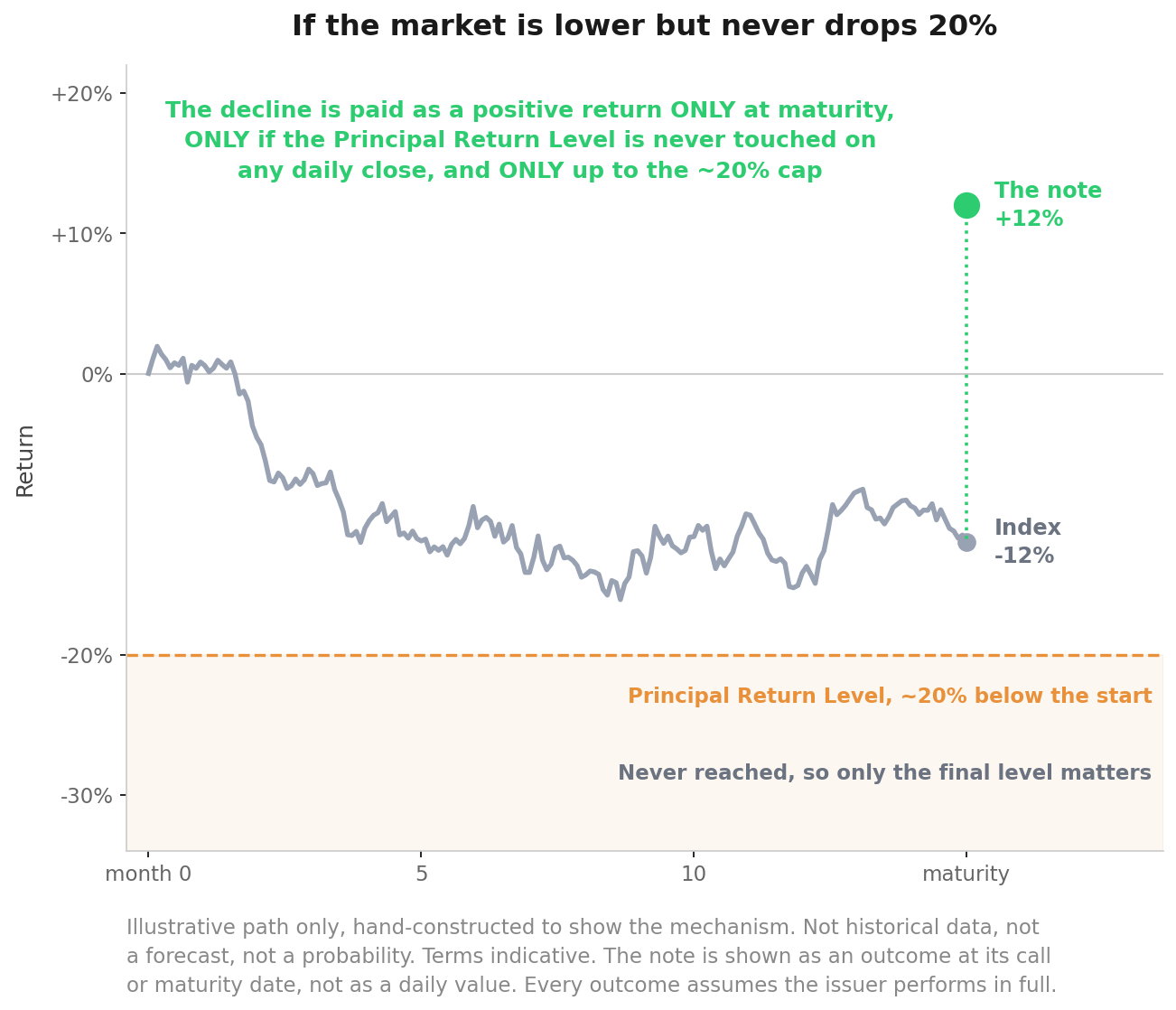
The market is down and the sleeve is up. The decline is paid as a positive return only at the fifteen month maturity, only if the Principal Return Level is never touched on any daily close, and only up to the ~20% cap. Those gains may then be redeployed at lower prices.
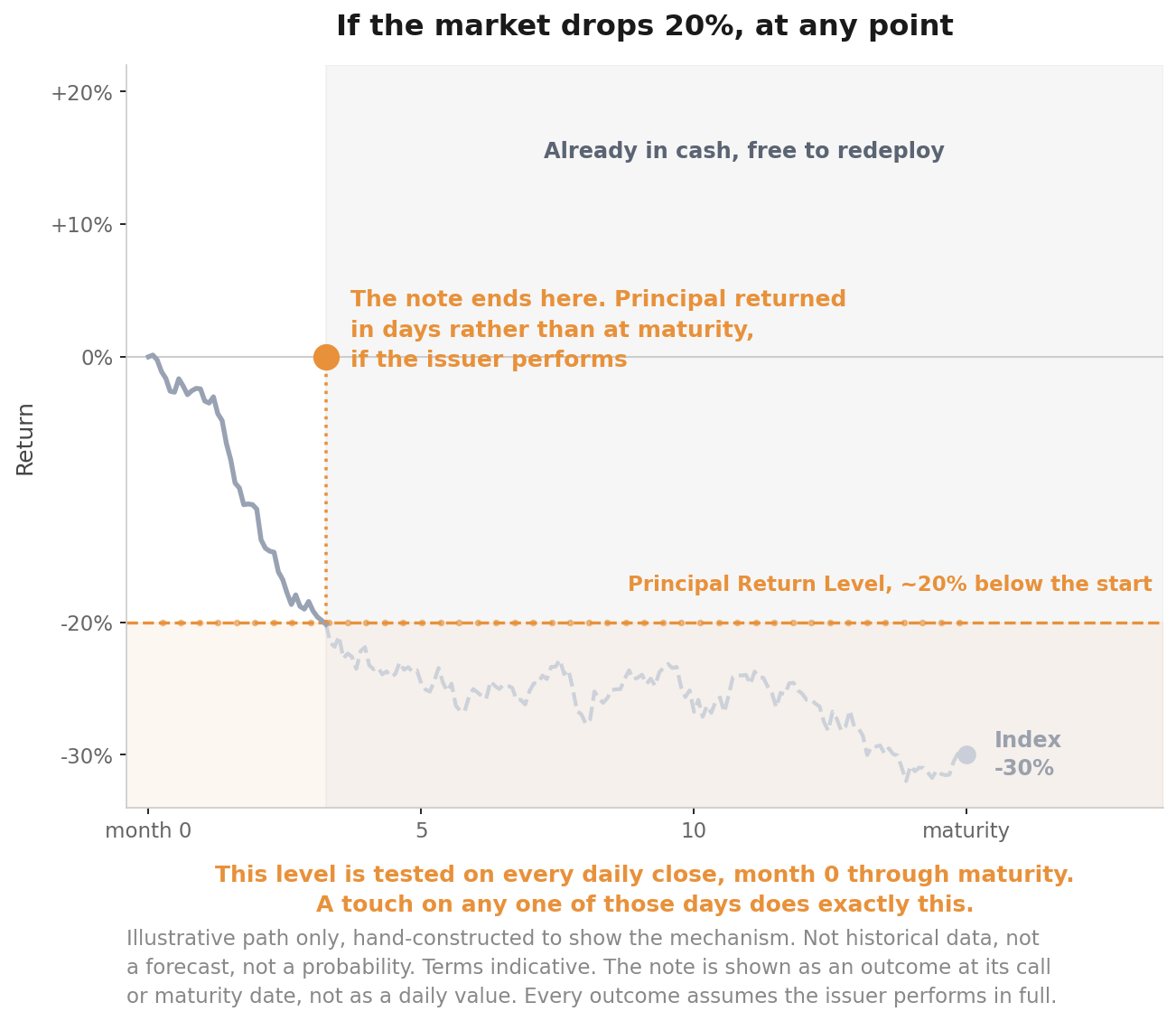
The moment the index closes at the Principal Return Level, on any single day of the fifteen months, the note ends itself and returns principal, subject to the issuer performing. Nobody has to decide when to take the hedge off, and the cash arrives while the market is still sold off.
Illustrative paths, not forecasts or probabilities · marinelayeradvisors.com/insights
Absolute Return Note with an Early Principal Return
RBC · S&P 500
If flat or up | ~5.30% fixed |
If down, level never reached | 1x the decline, paid as a positive return at maturity only, capped at ~20% |
Principal Return Level | ~80% of initial, tested on every daily close; principal returned early if reached |
Principal | 100% PPN. Return of principal depends on issuer creditworthiness. Notes are unsecured senior obligations of the issuer. |
Tenor | ~15 months |
The note pays no interest and does not accrue, so it is bond-like in outcome rather than in mechanics. An early principal return pays principal and nothing else: the gain there is what the cash may buy, not what the note pays. If you would like to institute this structure for your clients, it can be created on other indices as well, subject to issuer availability at the time of pricing (terms and prices may change of course).
These were indicative levels priced on 9/4/26. Pricing can vary depending on market conditions.
Happy to run terms on whichever index matters most to your book.
Any investment decision must be based solely on the issuer's prospectus and pricing supplement, which are available on request.
This material is intended solely for the recipient and may not be forwarded, reproduced or distributed to retail investors.
This material is for informational purposes only and does not constitute a recommendation or an offer to buy or sell any security. All terms shown are indicative, were priced by RBC on 9/4/26, are marked with a tilde where approximate, and are subject to change, final pricing, issuer availability and market conditions at the time of execution. They do not represent an offer or a quotation. Every outcome described in this material, including the return of principal, assumes the issuer of the note performs its obligations in full. These notes are unsecured senior obligations of the issuer and are not guaranteed, insured or collateralized. Return of principal depends on issuer creditworthiness: an issuer default, or a deterioration in issuer credit, could result in the loss of some or all of an investment regardless of how the referenced index performs. "Principal Return Level" is our plain-English description of the level at which the notes are automatically called at par, and is referred to in the offering documents as the knock-out, barrier or automatic call level; investors should rely on the offering documents and their defined terms. The notes pay no interest, do not accrue, are not listed on any securities exchange, may have limited or no interim liquidity, and their upside is capped. An early principal return pays principal only, with no return earned, and capital may have been held without earning interest. The illustrative paths shown are hand-constructed to demonstrate the mechanism: they are not historical data, not forecasts, and not probability estimates, and actual index paths and outcomes will differ. The date drawn in the third scenario is one illustration among many: the level is tested on every daily closing value, so a single close at or below it on any day during the term ends the trade at par regardless of where the index finishes. The note is shown in those paths as an outcome at its call or maturity date rather than as a daily value, because its value before then depends on secondary market pricing. Structured notes involve risks including potential loss of principal and may not be suitable for all investors. Past performance is not indicative of future results.