

RIA Ideas - Debasement Day
Trade Idea: Anti-Debasement
Gold is up 38% in twelve months. Bitcoin is 37% off its high. One structured note. Two anti-debasement assets.
On August 18, US public debt crossed $40 trillion for the first time. Treasury publishes the exact number every business day. That is not a political observation, it is a balance sheet fact. When a sovereign borrows without limit, hard assets with fixed supply tend to get bid. Since the crossing, gold is up +7.4% and IBIT is up +22.2%.
Gold and bitcoin are the same macro bet expressed differently:
- GLD: 5,000 years of precedent, central bank buying, already up +38.2% over the last twelve months. The move has happened. GLD is the priced version of the thesis.
- IBIT: institutional bitcoin, more volatile, more room to run. -12.2% year-to-date, still 37% below its October 2025 peak. Bitcoin is the unpriced version.
Both respond to the same thing: a dollar that buys less over time. Clients who want anti-debasement exposure do not have to pick one. They can hold both.
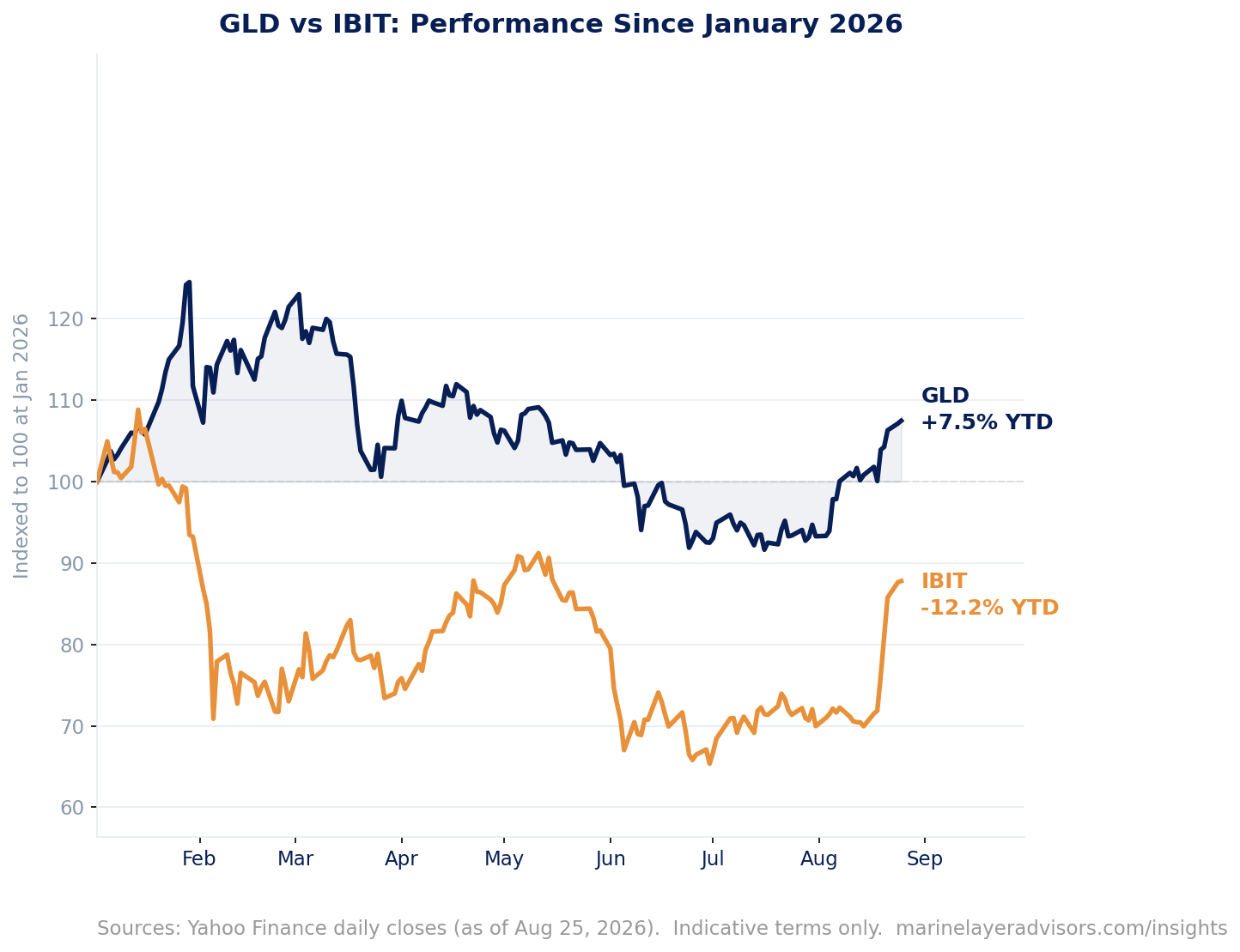
GLD and IBIT daily closes · Yahoo Finance as of August 25, 2026 · marinelayeradvisors.com/insights
On the IBIT side, there is a technical timing note worth mentioning: on August 19, bitcoin reclaimed its 200-day moving average after 289 straight days below. That has happened three other times since 2014 (June 2015, April 2019, January 2023). Twelve months later bitcoin was higher each time: +152%, +35%, +115%. Small sample, not a forecast. But it lines up with the macro.
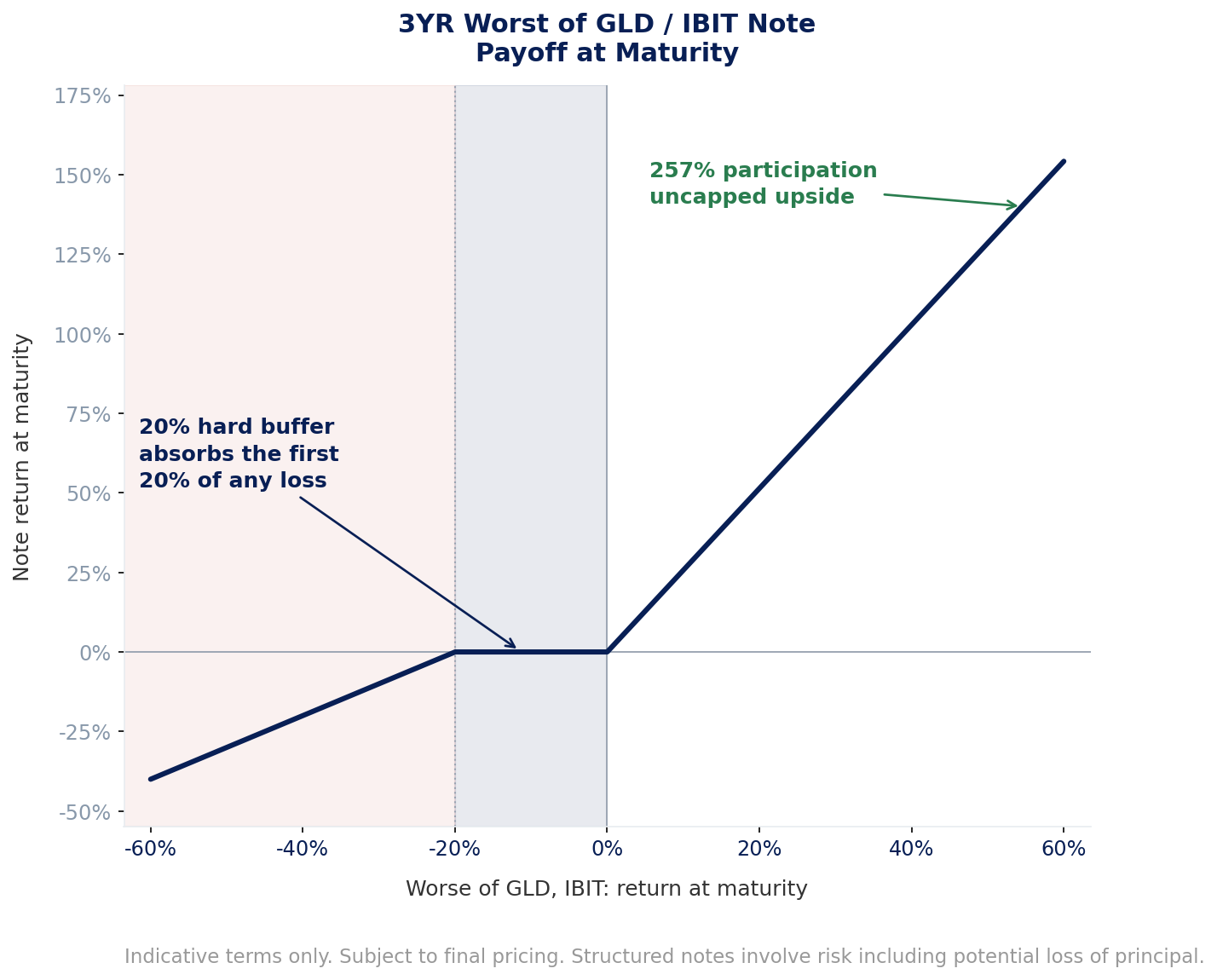
The structure below lets a client hold both in one position. Instead of choosing which debasement play to own, the note participates in whichever one performs worst at maturity (and still pays 257% of that return). A 20% hard buffer absorbs the first 20% of losses from the weaker asset. Clients who believe the thesis hold a buffered, levered claim on the anti-debasement trade across both assets.
INDICATIVE TERMS · SUBJECT TO FINAL PRICING
3-Year Growth Note
Worst of GLD (SPDR Gold) / IBIT (iShares Bitcoin Trust)
Upside participation | 257%, uncapped |
Downside protection | 20% Hard Buffer |
If both assets are flat to up | 257% of the worse performer's gain |
If worse-of falls 0% to 20% | Principal returned in full |
If worse-of falls more than 20% | Loss equals the decline beyond 20% |
Tenor | 3 years |
At maturity, if both GLD and IBIT are up, the note pays 257% of whichever gained less. If the weaker asset is down but by no more than 20%, the buffer absorbs the loss and the investor receives full principal. Only if the weaker asset falls more than 20% does the investor lose, and only the amount beyond the buffer. No cap on the upside.
Terms are live. Issuer: Morgan Stanley. Email us for a CUSIP.
The $40T debt figure is straight from the Treasury's own daily dataset: Debt to the Penny. Worth bookmarking if a client asks where the number comes from.
Who on your book is asking about inflation protection or wants exposure to real assets without the volatility of holding crypto outright?
Send me a name and a notional and I will get you a live quote today.
This material is for informational purposes only and does not constitute a recommendation or offer to buy or sell any security. Price and performance data sourced from Yahoo Finance daily closes as of 8/25/2026 (August 25, 2026); total public debt outstanding sourced from the US Treasury Bureau of the Fiscal Service Debt to the Penny dataset. The 200-day moving average reference is a simple moving average computed on BTC-USD daily closes; the prior-signal returns shown are historical observations over a sample of three occurrences and are not a forecast. Past performance is not indicative of future results. Structured notes involve risks including potential loss of principal. All terms are indicative, subject to final pricing, and dependent on issuer credit risk, market conditions, and availability at time of execution. In a Worst of structure, the note's return at maturity is determined by the lower-performing of the two underliers; investors accept this linkage in exchange for the enhanced participation rate and buffer protection described above.